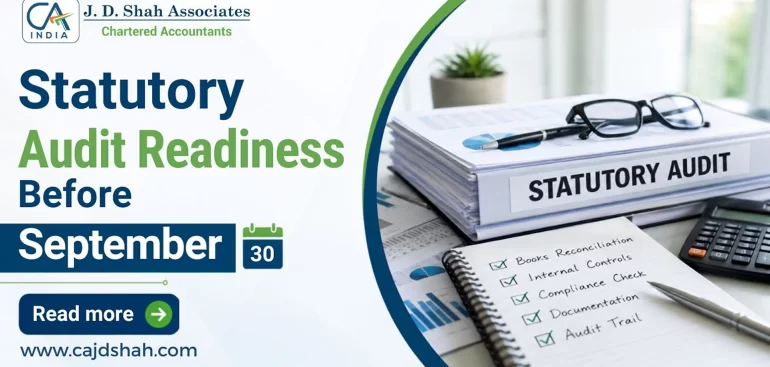
Every year around this time, the same pattern plays out. August rolls in, and businesses realise that the statutory audit deadline of September 30 is barely six weeks away. Books that were meant to be updated month on month are now several quarters behind, vendor reconciliations are only half complete, and someone is scrambling to locate a fixed asset invoice from months ago.
This is a pattern most chartered accountant firms in Mumbai see repeat every season. Businesses that work closely with a tax consultant in Mumbai through the year rarely feel the same crunch, because the reconciliation work has already been happening quietly in the background.
Statutory audit readiness is rarely about a last minute push. It comes down to a few disciplines followed consistently through the year. For companies and firms whose accounts need to be audited under the Companies Act or the Income Tax Act, here is what deserves attention right now, well before the deadline closes in.
1. Reconcile Your Bank Statements First
This sounds basic, but it is where most delays start. If your bank reconciliation statement is not current, nothing downstream can really be trusted. Pull your bank statements for the full year, match them against your books, and flag every unexplained entry now, not in September.
Common gaps we run into:
- Cheques issued but not yet presented, sitting in the books for months
- Bank charges or interest that were never recorded
- Old unreconciled entries carried forward from the previous year
Tip: if your reconciliation has entries older than 90 days, that is usually a sign something was missed, not just a timing difference.
2. Match Your GST Returns with the Books
Auditors will always tie out your GSTR-3B, GSTR-1, and GSTR-2B against the revenue and input tax credit recorded in your books. If there is a mismatch, be ready to explain it, because you will be asked.
- Check if the turnover in GSTR-1 matches your sales ledger
- Confirm that ITC claimed in GSTR-3B agrees with what is showing in GSTR-2B
- Reverse any ineligible credit before the audit, not after it gets flagged
A lot of businesses only look at this once a year when the audit comes around. If you already work with a GST consultant through the year, this becomes a quick check rather than a last minute scramble.

3. Close Out TDS and TCS Reconciliations
Similar story here. Match the TDS deducted and deposited against Form 26Q filings and Form 26AS. If a vendor payment was made without deducting TDS, or a challan was deposited under the wrong section, it needs to be corrected well before the auditor sits down with your books. Most tax consultants in Mumbai recommend running this reconciliation every quarter instead of waiting until the audit, since these errors have a way of surfacing at the worst possible time.
4. Sort Out the Fixed Asset Register
This one gets neglected more than people realise. Every addition and deletion during the year should be reflected in the fixed asset register with proper supporting invoices, and depreciation should be computed correctly under both the Companies Act and Income Tax Act, since the two often diverge.
- Physically verify major assets if it has not been done recently
- Write off assets that are no longer in use, instead of letting them sit on the books
- Keep purchase invoices and installation details organised by asset, not buried in a folder somewhere
5. Review Related Party Transactions
Under the Companies Act and Ind AS, related party disclosures get real scrutiny. List out every transaction with directors, group companies, or relatives during the year, and check whether board approvals or shareholder resolutions were taken where required. Missing paperwork here is one of the most common audit observations we come across.
6. Get Inventory Records Right
If your business carries stock, your closing inventory needs to tie back to a physical count, valued consistently with your accounting policy, whether that is FIFO, weighted average, or something else. Auditors will usually want to see the stock take working papers, so keep them ready rather than reconstructing them after the fact.
7. Close Provisions and Accruals Properly
Expenses relating to the year should be booked in that year, even if the invoice arrives later. This includes audit fees, bonus provisions, gratuity, leave encashment, and any pending statutory dues. Skipping these is one of the quickest ways to end up with a qualified audit report.

8. Keep Statutory Registers and Documents Ready
Beyond the accounts themselves, auditors will ask for board meeting minutes, statutory registers, loan agreements, and compliance filings under the Companies Act. Keep a checklist of what is due for the year and get it signed off well before the audit team arrives, so nobody is chasing paperwork on the last day.
For businesses eyeing an IPO in the next few years, this discipline matters even more. Anyone who has worked with an IPO consultancy will say that clean, audit ready books going back several years are usually the first thing investment bankers and regulators look at, long before the first draft prospectus is filed. Waiting until the process starts to fix historical gaps rarely works.
How Professional Audit Support Can Help
Getting audit ready is not just about ticking boxes before the deadline, it is about building a system where your books are always close to audit standard. That takes a bit of discipline through the year, and honestly, most internal teams are stretched too thin to manage this alongside their regular work.
JD Shah Associates is a chartered accountant and auditing firm in Mumbai working with businesses through the year, not just at audit time. Our services include:
- Statutory and tax audits under the Companies Act and Income Tax Act
- Tax consultant support in Mumbai for individuals, professionals, and businesses
- GST consultant services, from monthly return filing to reconciliation
- Fixed asset and inventory verification
- IPO consultancy and listing readiness for companies preparing to go public
If you are looking for a chartered accountant firm in Mumbai to help get your books audit ready, our team is here to help.
Final Thought
The September 30 deadline feels far away in April and uncomfortably close in August. The businesses that handle it well are usually the ones that treated audit readiness as an ongoing habit rather than a once a year fire drill. Start the reconciliations now, clear the gaps you already know about, and the audit itself becomes a formality instead of a headache.
If you are searching for the best CA firm in Borivali, Mumbai to get there, JD Shah Associates is here to help.