“The accounts are final. What else do you need?”
It’s a fair question. You’ve closed the books, checked the profit, and sent the file to your CA. Then comes a request for a supplier’s payment date or the explanation behind a GST difference. The accountant who handled it has moved on, and the answer is somewhere in an old email.
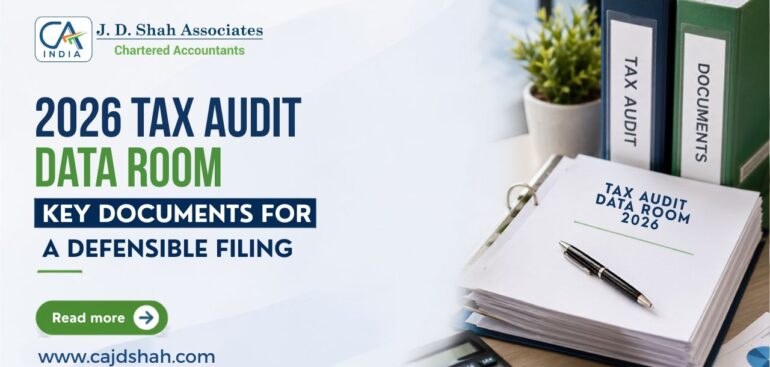
This tax audit documents checklist for 2026 covers the documents required for a tax audit in India and the questions your CA will ask: “Where did this number come from?” A tax-audit data room is one secure folder holding the records behind each answer. We suggest organising it around those questions, not by uploading files and hoping nothing is missing.
A quick note on the year: This tax audit checklist for AY 2026–27 covers April 2025 to March 2026. Those audits still use Form 3CA or 3CB with Form 3CD, as applicable. Start a separate folder for April 2026 to March 2027, which falls under the new Act and uses Form 26. Label both folders with their actual start and end dates so invoices don’t get mixed up.
Who Needs a Tax Audit?
Before you treat this checklist as compulsory, check where you stand. For FY 2025–26, the usual Section 44AB limits look like this:
| Who | Audit usually needed above | Presumptive scheme limit |
| Business | ₹1 crore turnover (₹10 crore if cash receipts and cash payments are each 5% or less) | Section 44AD: ₹2 crore (₹3 crore if cash receipts are 5% or less) |
| Professional | ₹50 lakh gross receipts | Section 44ADA: ₹50 lakh (₹75 lakh if cash receipts are 5% or less) |
Declaring the prescribed presumptive income under Section 44AD or 44ADA can remove the audit requirement. Claiming a lower income, or opting out of Section 44AD, needs an individual review, so check applicability with your CA before you decide.
1. Which Version of the Books Is Final?
A folder containing three files named “final accounts” leaves everyone guessing. Agree on one reviewed version, then include:
- The trial balance and ledgers, so each financial-statement figure can be traced to its entries.
- The balance sheet, profit and loss account, and adjustment workings, so year-end changes have an explanation.
- A readable accounting backup, so the auditor can examine transactions behind the summaries.
PAN, TAN, GST registrations, and the incorporation documents or partnership deed belong here too. Any change to the business during the year needs recording.
2. Can You Explain Every Bank Balance?
A bank statement gives you dates and amounts. Loan agreements and invoices explain what each payment relates to.
Alongside statements for every business account, including closed accounts and payment gateways, add year-end reconciliations explaining uncleared entries. Loan agreements, interest workings, and relevant balance confirmations help explain borrowing and outstanding amounts.
If a customer paid less because they deducted TDS, the bank receipt and invoice won’t match directly. The reconciliation should explain that difference.

3. GST Reconciliation for Tax Audit
GST differences can take longer to explain than anyone expects. Your books show one turnover, GSTR-3B shows another, and nobody remembers why.
Sometimes there’s a valid timing difference. A service advance, for instance, may appear in GST reporting before it becomes revenue in the books. Without a written explanation, somebody has to reconstruct the transaction under deadline pressure.
So bring the sales and purchase registers, invoices, credit notes, and GSTR-1, GSTR-3B, and GSTR-2B together. Add a reconciliation explaining turnover differences and input-tax-credit discrepancies, with references to the supporting records. We’d rather review a difference you’ve identified than find an unexplained one while finalising the audit.
4. Expense Bills and Related-Party Payments
“Consultancy charges” tells your CA very little. What work was done, who did it, and how did it relate to the business?
The agreement, invoice, payment record, and evidence of delivery should answer those questions together. The same approach helps with rent, commissions, and significant travel expenses.
Related-party payments deserve a separate schedule identifying the person, relationship, and transaction. Personal spending, cash payments, and expenses that may need tax adjustments should also be easy to spot.
5. MSME Payment Records for Section 43B(h)
For MSME suppliers, the payment date can affect your tax deduction. The closing balance is only part of the information your CA needs.
For eligible micro and small enterprise suppliers, your CA needs registration evidence or declarations, invoices, agreed payment terms, acceptance dates where relevant, and actual payment dates. An invoice-wise ageing schedule brings those details together, including unpaid year-end amounts and documented disputes.
Section 43B(h) can change the year in which a deduction is available. Our advice is to establish each supplier’s eligibility and payment timing before calculating taxable income.
6. Payroll and TDS Reconciliation for Tax Audit
Salary recorded in the books, tax deducted, and amounts deposited should tell a consistent story. Payroll registers, salary workings, TDS/TCS returns, challans, and applicable PF and ESI records make that comparison possible.
If a deposit was late or a return needed correction, include the dates and correction records. Employee and employer contributions should be shown separately because their deduction rules differ.
For the business’s own tax credits, reconcile Form 26AS and AIS with the books and explain discrepancies.
7. What Supports Your Assets and Closing Stock?
A machine’s purchase date and the date it started operating may be different. That matters for depreciation, so the fixed-asset register needs invoices, disposal details, and evidence of when additions were put to use. Tax depreciation also needs its own working, separate from the accounts.
For stock-holding businesses, the useful records are:
- Stock counts and quantity records that explain what was actually on hand at year-end.
- Valuation workings and write-off details that explain how those quantities became the closing-stock figure.
If damaged stock was reduced in value, document the condition and the basis for that reduction.
8. Can You Follow the Calculation Through to Filing?
Accounting profit is the starting point. Your tax computation should show how adjustments, depreciation, deductions, and supported brought-forward losses lead to taxable income.
The Form 3CD supporting documents should explain the figures reported in the audit statement and any adjustments carried into your return.
Earlier returns, relevant assessment orders, and advance-tax and self-assessment-tax challans belong alongside that working. Once filing is complete, add the final audit report, taxpayer acceptance acknowledgement, ITR acknowledgement, and verification evidence.
Access should be limited to the people who need these records. Agree on an owner for the folder and check retention requirements with your CA.

What We’d Want to Resolve Before Filing
Before sending the folder, ask: which differences remain unexplained, which documents are missing, and who will provide them? Give each open item a name and a date.
At JD Shah Associates, we can help review the records and reconciliations behind your tax audit and return. If a supplier confirmation is missing or a GST difference still needs investigation, speak to us while there’s time to follow it up. Those are much easier conversations before filing day.
FAQ
Q. What documents are required for a tax audit in AY 2026–27?
Start with final accounts and ledgers, bank statements, GST and TDS reconciliations, MSME payment records, asset and stock workings, and the tax computation. Your CA may request additional records depending on your business and transactions.
Q. Is a tax audit mandatory for every business?
No. It depends on turnover or gross receipts, cash-transaction levels, and whether you’re under a presumptive scheme. The thresholds above are the starting point, and your CA can confirm your position.
Q. What is the tax audit report due date for AY 2026–27?
For persons covered by the CBDT’s 28 September 2026 extension, the audit-report date is 21 October 2026 and the return due date is 21 November 2026. A formal order was to follow, so confirm with your CA.
Q. Which form is used for FY 2025–26?
Form 3CA if your accounts are already audited under another law, otherwise Form 3CB, in both cases with Form 3CD. Form 26 applies from Tax Year 2026–27.
Q. Do I need a data room if I’m not required to get audited?
It isn’t a statutory requirement. It’s simply good practice, and the same records help with a clean return or a later notice.