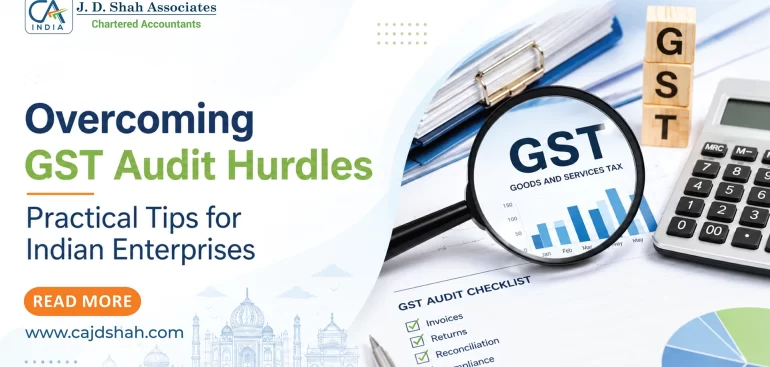
GST audits. Two words that make most business owners reach for a glass of water. Whether you run a mid-sized manufacturing unit or a service firm, the moment you get that notice from the GST department, things tend to get stressful fast. And honestly, that stress is often not about hiding anything. It is usually about not being prepared, records that do not match up, or just not knowing what the auditors are actually looking for.
Here is a practical breakdown of where most Indian enterprises stumble during GST audits and what you can do about it.
1. Understand What Kind of GST Audit You Are Facing
Not all GST audits are the same, and treating them all with the same response is a mistake.
There are broadly three types:
- Departmental audit under Section 65 of the CGST Act, conducted by a GST officer at your business premises
- Special audit under Section 66, directed by a GST Commissioner if the accounts seem complex or unreliable
- Annual return audit through GSTR-9C, which is a self-certified reconciliation statement filed by taxpayers with turnover above a specified threshold
Each type requires a different level of preparation. A departmental audit will require you to present physical books and records. A GSTR-9C demands a clean reconciliation between your audited financials and your GST returns. Knowing what you are up against shapes how you prepare.
2. The Documentation Problem
This is the single most common issue we see. Businesses file their GST returns on time, pay their taxes, and still end up in trouble because they cannot produce the supporting documents when asked.
Here is what auditors typically want to see:
- Tax invoices and credit notes in the prescribed format
- Purchase registers and sales registers
- E-way bills for goods movement
- Bank statements reconciled with return data
- Contracts and agreements for high-value transactions
- Proof of export for zero-rated supplies
Many businesses, especially smaller ones, store these haphazardly across email folders, WhatsApp messages, and physical files. When an auditor asks for invoices from 18 months ago, that is when panic sets in.
The fix is not complicated. Maintain a structured digital archive of all GST-related documents, tagged by month and GSTIN. Your tax consultant in Mumbai or wherever you are based can help set up a basic compliance tracker if you do not have one already.
3. Input Tax Credit Claims That Invite Scrutiny
ITC is probably where most audit disputes originate. The rules around input tax credit are detailed, and even genuine claims get challenged if they are not supported properly.
Watch out for these common ITC issues:
- Claiming ITC on purchases where the supplier has not filed GSTR-1 or has filed it incorrectly
- ITC claims on goods or services used for personal purposes or exempted supplies
- Blocked credits under Section 17(5), such as motor vehicles, food and beverages, or works contract services, that businesses often claim without realising they are ineligible
- ITC claimed in one period but the invoice date falling in another, causing mismatches
The GSTR-2B auto-populated statement is your friend here. Cross-check every ITC claim with GSTR-2B before you file. If there is a mismatch, resolve it before it becomes an audit issue. A good GST consultant will build this check into your monthly compliance routine.
4. Mismatches Between GSTR-1 and GSTR-3B
GSTR-1 captures your outward supply details. GSTR-3B is your summary return with tax payment. When these two do not match, it raises an automatic flag in the GST system.
Common reasons for mismatches:
- Invoices uploaded in a different tax period than when they were issued
- Amendments made in GSTR-1 but not reflected in GSTR-3B
- Rounding-off errors that accumulate over months
- Credit notes not properly adjusted in both returns
The GST department uses automated data analytics to spot these discrepancies. Even small, repeated mismatches can trigger a scrutiny notice. The solution is monthly reconciliation. Do not wait for the annual return period to discover six months of discrepancies.

5. E-Way Bill Gaps and Physical Movement
For businesses dealing in goods, e-way bill compliance is a major audit trigger. Auditors cross-check e-way bill data with your invoices, and any gaps raise questions about whether the physical movement of goods actually happened.
Common issues here include:
- E-way bills generated but goods never moved, or vice versa
- Discrepancies between the quantity on the invoice and what the e-way bill shows
- Expired e-way bills where the goods were still in transit
- Vehicle number mismatches in cases of Part B updates not done correctly
If your business involves frequent inter-state movement of goods, a quarterly review of e-way bill data against your sales register is a basic necessity. This is something your auditing firm should be doing as part of routine compliance checks, not just at year-end.
6. Reconciliation of Books vs GST Returns
When an auditor sits across from you, one of the first things they will do is compare your audited financial statements with your GST returns. If the turnover in your books does not match the taxable turnover in your GSTR-9, there will be questions.
The differences are sometimes legitimate, such as:
- Exempt supplies that appear in your books but not in GST returns
- Advances received and adjusted differently in accounting versus GST
- Unbilled revenue recognised in accounts but not yet invoiced under GST
These differences are explainable. The problem is when businesses cannot explain them. Prepare a formal reconciliation statement for your auditor that clearly maps every variance between your books and your GST returns. This single document can prevent hours of back-and-forth questioning.
This is exactly the kind of work that a proper auditing firm will handle as part of annual GST audit support. Do not try to wing it on your own during the actual audit.
7. How Timely Professional Help Makes the Difference
There is a pattern we have seen consistently. Businesses that engage a GST consultant or tax consultant early, well before the audit notice arrives, tend to have far fewer issues. Not because the consultant hides anything, but because the compliance gaps get caught and corrected before they become audit findings.
Here is what good professional support looks like in practice:
- Monthly reconciliation of GSTR-1, GSTR-3B, and GSTR-2B
- Annual GSTR-9 and GSTR-9C preparation with proper reconciliation notes
- Pre-audit health checks, where the firm reviews your records before a notice even arrives
- Representation before GST officers during departmental audits
- Advisory on complex transactions like related-party supplies, export refunds, or sector-specific exemptions
If your business is based in Maharashtra, working with an experienced tax consultant in Mumbai who understands both state-specific issues and central GST provisions can make a real difference. The same goes for businesses in other metros. Local knowledge of how particular GST offices operate, what they tend to focus on, and how to frame your responses is genuinely valuable.
Beyond GST, businesses going through growth phases should also be aware that compliance requirements shift. Whether you are approaching the IPO consultancy stage, dealing with RERA consultants for real estate projects, or simply scaling up your operations, your GST compliance footprint grows with you. Getting the foundation right early saves significant trouble later.
8. Final Thought
A GST audit does not have to be a nightmare. Most businesses that struggle with audits do so not because they are non-compliant at heart, but because they never built the systems to stay consistently organised.
Start with the basics. Keep your records clean. Reconcile monthly. Flag discrepancies when you spot them rather than hoping they will not come up. And work with professionals who treat compliance as an ongoing responsibility, not just a year-end fire drill.
At JD Shah Associates, we work with enterprises across industries on GST compliance, audits, and advisory. If you are heading into an audit or just want to tighten up your compliance before the department comes calling, our team is here to help.