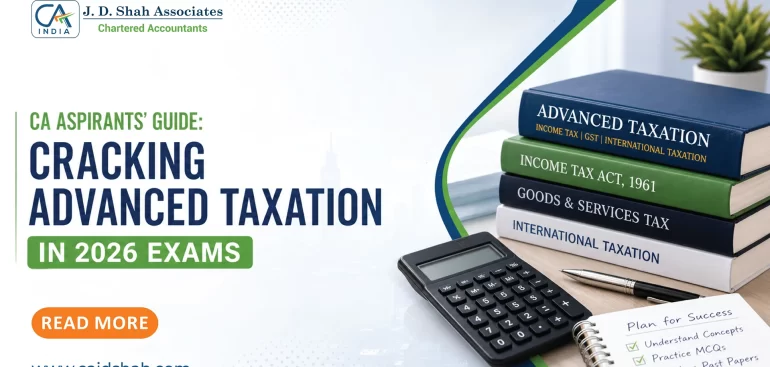
Let’s be honest. Most CA Final students open the Advanced Taxation paper on exam day and feel like they studied a slightly different subject. The numbers are off. The scenario is twisted. And whatever they memorised the night before just doesn’t fit.
That’s not bad luck. That’s what happens when you study tax law like it’s a history textbook instead of a living, applied subject.
Advanced Taxation in 2026 rewards students who understand how the law works in practice. Not just what Section 54 says. But when it applies, when it doesn’t, and what happens at the edges. The ICAI has been pushing this direction for a few years and the 2026 pattern makes it very clear.
1. What Has Actually Changed in 2026
ICAI has been gradually shifting this paper away from straight recall towards application. The 2026 version is the most applied it’s been in years.
What that looks like in practice: you might get a single integrated problem that touches income tax computation, a GST classification issue, and a transfer pricing flag. All in one question. Not as separate parts. As one business scenario where everything is connected.
Students who studied each topic in isolation get caught out. The ones who understood the logic behind the law move through it a lot more smoothly.
A few specific shifts worth noting:
- GST carries more weight now than it did even two years ago
- International taxation questions are longer and scenario-heavy
- Assessment and appeal procedures are back with more depth
- Transfer pricing is no longer a section you can skim and hope for the best
If your preparation is built on a 2023 pattern approach, you need to reset. The paper has moved on.

2. Topics That Separate the Scorers from the Rest
Some topics show up every single year. Some carry disproportionate marks. And some are the ones where good students drop points they shouldn’t. Knowing which is which matters more than trying to cover everything equally.
Topics you cannot afford to be shaky on:
- Capital gains. Budget amendments have changed the landscape here. Know the new holding period rules and exemption limits cold.
- GST place of supply. It trips people up because it feels straightforward until the scenario gets cross-state or involves services. Spend real time on this.
- TDS and TCS. Examiner favourites, consistently. Rates, thresholds, due dates, consequences of non-deduction. All of it.
- Chapter VI-A deductions. The details count. Not just knowing which section covers what, but limits, conditions, and interaction with new tax regime.
- Corporate tax and MAT. Comprehensive problems combining both come up regularly.
Topics students underestimate and then regret:
- Taxation of trusts and charitable institutions
- Tax implications in mergers, demergers, and slump sales
- DTAA relief provisions
The tax consultants who mentor students through articleship say the same thing repeatedly: it’s almost never the hard topics that cost students marks. It’s the familiar ones they didn’t sharpen properly.
3. GST: Stop Reading, Start Mapping
GST is where students either build a solid lead or fall apart. Rarely in between.
The challenge isn’t that the subject is too vast. It’s that it keeps changing. Council decisions, notifications, circulars. The study material from six months ago may already have gaps. And the examiner is current.
The students who do well don’t just read GST. They map it. They draw out the supply chain. They build tables for ITC eligibility. They practise place of supply rules with actual scenarios, not just definitions.
Practically, focus on:
- CGST Act, section by section, not chapter summaries
- ITC: eligible credits on one side, blocked credits on the other, in one reference table you built yourself
- Place of supply: draw every scenario out. The diagram sticks better than the text.
- Amendment tracker maintained from July 2024 GST Council onwards
- GSTR filing timelines revised separately, they show up in short answer questions
Spending even a few weeks working alongside a proper GST consultant during articleship does something that months of solo reading can’t. When you see how a business actually reconciles GSTR-2B against its books, how disputed ITC gets handled, how multi-state businesses manage their supply chain compliance, the law starts to make sense in a completely different way.
4. Income Tax: Where Confident Students Lose Marks
Income tax feels familiar. Most students have touched it during articleship. They’ve filed returns. They know some provisions. And that comfort is exactly what costs them.
They walk into the exam hall thinking income tax is safe territory and then drop marks in the sections they thought they had covered.
The actual traps:
Residential status and scope of total income.
This appears every few years and almost every time, students who thought they knew it fumble the application under exam pressure. Practise this with actual numerical problems, not just theory reading.
Capital receipts versus revenue receipts.
The distinction matters enormously for tax liability and it requires case law familiarity. Don’t skip the landmark judgements on this one.
Set off and carry forward in combined problems.
Students know the individual rules but when everything is stacked together in a long-form income computation, errors creep in. You need to practise end-to-end problems, not just section-wise revision.
Search and seizure provisions.
Feels obscure. Keeps appearing. Give it a few hours. You’ll thank yourself in the exam.
Every good tax consultant will say the same thing: income tax is not hard, it’s detailed. The skill is organizing facts systematically before you start computing. That’s what gets you marks in the exam and what makes you genuinely useful in practice.

5. International Taxation Is Not Optional Anymore
For years, students treated international tax as the section to read once, hope you don’t get a big question on it, and move on. That approach has stopped working.
ICAI has been increasing both the depth and the frequency of international tax questions in the final paper. And honestly, given the kind of work that’s happening at firms offering IPO consultancy, outsourcing services, and cross-border advisory in Mumbai, this is also one of the most career-relevant parts of the syllabus.
What to actually focus on for 2026:
- DTAA: both the exemption method and the credit method, with numbers
- Permanent Establishment: know what triggers it and what doesn’t, with examples
- Transfer pricing: all six methods, which one applies when, and what documentation looks like
- POEM: understand the India angle and when it gets triggered for foreign companies
- BEPS: you don’t need all 15 action plans, but know the ones that directly affect Indian tax positions
If you can get access to even two or three actual ITAT orders on transfer pricing disputes, read them. Not to memorise facts but to see how the law plays out in a real argument. It makes the study material feel much less abstract
6. Why Articleship Exposure Changes Everything
Some students clear CA Final on their first attempt with decent scores and no exceptional coaching. Others spend multiple attempts and can’t crack it despite good memory and hard work.
The difference is rarely intelligence. It’s almost always whether they actually understood what they were studying or just processed it. And practical exposure is what builds that understanding.
If you’re still in articleship, be deliberate about what you engage with. A good chartered accountant firm in Mumbai that handles a real mix of statutory audit, income tax assessments, GST compliance, and advisory work will expose you to scenarios that no study material covers properly.
Things worth actively seeking out:
- Sit in on a tax assessment or appeal hearing if your firm handles them, even as an observer
- Work on a GSTR-2B to books reconciliation yourself, not just watch someone else do it
- Ask your seniors about why a particular tax planning structure was chosen for a client
- If transfer pricing work happens at your firm, get involved even in the documentation part
The best CA firms consistently say that students who are curious during articleship, who ask why and not just how, show up to exams differently. They’re not just answering questions. They’re reasoning through problems. That’s what the 2026 paper is actually testing.
7. Revision That Gets Results
The month before the exam is when most students start making bad decisions. New topics. Binge-watching lecture videos. Trying to read the full study material one more time from the beginning.
None of that works well under time pressure. Revision should consolidate what you know, not introduce new uncertainty.
What actually helps:
- Past papers under real exam conditions. Not reading them. Not checking the solution after every question. Sitting down, timer running, and solving the full paper. Then reviewing.

- One consolidated amendment document. Not multiple sources. One tracker you’ve built yourself for everything post-Budget 2024. Revise that repeatedly.
- 15 to 20 landmark case laws, understood deeply. Not a list of 80 names and sections you’ve half-memorised. Know fewer cases properly, with the principle each one stands for.
- Answer format practice. The way you present an income computation, the order in which you deal with adjustments, the format of a transfer pricing analysis. These things matter to the examiner. Practise writing, not just reading.
- At least two full mock papers. Use the ICAI revision test series or a credible coaching source. Full papers, timed, reviewed properly.
Also worth knowing: the paper has 100 marks but you don’t need to attempt everything perfectly. Knowing which questions to take on first and which ones to leave for later is its own skill. Practise that deliberately in your mock attempts.
8. Wrapping Up
Advanced Taxation in 2026 is not a paper you crack by reading harder. You crack it by understanding the law well enough to apply it to situations you’ve never seen before.
The students who clear it on the first attempt are not always the ones who studied the most hours. They’re the ones who built real clarity on the core concepts, stayed updated on amendments, practised application consistently, and walked into the exam knowing how to think through a problem, not just recall an answer.
Whether you’re preparing solo, working through coaching, or doing articleship at one of the established auditing firms in the city, the approach is the same. Understand deeply. Practise application. Stay current.
At JD Shah Associates, we see students at all stages. The ones who make it through this paper are almost always the ones who stopped treating it like a memory test and started treating it like the professional subject it actually is.
JD Shah Associates, one of the more established chartered accountant firms in Mumbai, we work with students, freshers, and experienced practitioners every day. This guide pulls from that exposure. Take it as a senior colleague talking to you, not another online resource rehashing the syllabus.