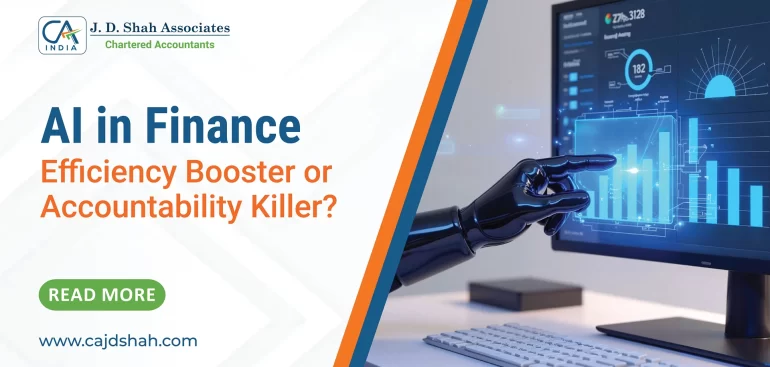
AI is everywhere right now. It is in your inbox, your accounting software, your bank’s fraud detection system, and probably in the tool your CA firm uses to reconcile your GST data. And honestly, that is not a bad thing.
But there is a conversation that is not happening loudly enough. Because for every finance team that has genuinely saved time using AI, there is another that has made an error they do not fully understand, signed off on a report they did not fully read, or outsourced a judgment call to a system that has no concept of accountability.
We see both sides of this at JD Shah Associates. As a practicing auditing firm and tax consultant in Mumbai for over two decades, we have watched technology reshape this industry in real time. Here is what we actually think about AI in finance, without the hype.
What AI Is Actually Doing in Finance Right Now
Let’s be specific. AI in finance is not one thing. It is a collection of tools doing very different jobs:
- Automated bookkeeping and bank reconciliation
- GST return preparation and error-flagging
- Invoice matching and accounts payable processing
- Fraud detection in banking and insurance
- Financial forecasting and scenario modelling
- Audit sampling and anomaly detection
Some of this is genuinely useful. Some of it is being oversold. And some of it is creating risks that businesses and even accounting professionals are not fully aware of yet.

Where It Genuinely Helps
Routine work. That is where AI earns its keep.
If your finance team is spending hours every month manually matching invoices, reconciling bank statements, or chasing down GST mismatches, a good AI-powered tool can cut that time significantly. We are talking about tasks that are repetitive, rule-based, and high volume. AI handles those well.
For a mid-sized business in Mumbai dealing with hundreds of purchase orders and vendor invoices monthly, the time savings are real. The error rate from manual entry drops. The team can focus on work that actually requires thinking.
Chartered accountant firms in Mumbai that have integrated AI tools into their practice are seeing faster turnaround on compliance work. That is a good thing for clients. It means faster filing, fewer last-minute scrambles, and more time for actual advisory conversations.
The Efficiency Gains Are Real, But So Are the Blind Spots
Here is where it gets complicated.
AI works well when the data going in is clean and the rules are clear. But finance is full of situations where the data is messy and the rules have exceptions. A GST consultant dealing with a complex multi-state supply chain, or an auditing firm reviewing a company with unusual revenue recognition policies, is working in territory where pattern-matching tools frequently get it wrong.
The bigger problem is that AI is confident even when it is wrong. It does not flag uncertainty the way a trained professional does. It produces outputs that look complete and authoritative. And busy finance teams, under pressure to move fast, often do not look closely enough.
We have seen cases where automated tools flagged legitimate transactions as anomalies and missed actual irregularities sitting in plain sight. The tool was doing what it was built to do. The issue was that no one reviewed the logic carefully enough.
The Accountability Problem Nobody Talks About
This is the part that concerns us most.
When a professional signs off on a financial statement or a tax return, they are accountable. Their name is on it. Their registration is on the line. That accountability shapes how carefully the work is done.
When an AI tool produces an output and a human quickly approves it without really understanding what the system did, accountability gets thin. If an error surfaces later, who is responsible? The software vendor? The person who clicked approve? The business that relied on the output?
In the context of income tax, GST compliance, and audit, this is not a theoretical concern. Errors have real consequences. Notices from the department, penalties, interest, reputational damage. And the Income Tax Act and GST law hold the taxpayer and their authorized representative accountable, not the software.
If you are a business relying on automated tools and assuming someone else is checking the output, that is a risk worth taking seriously.
What This Means for Businesses in Mumbai
Mumbai is one of the most commercially active cities in the country. Businesses here deal with high transaction volumes, complex supply chains, foreign exchange, cross-border services, and multiple tax jurisdictions. The compliance load is significant.
AI tools can help manage that load. But they work best as a support layer, not a replacement for professional oversight. The best ca firm in Borivali Mumbai or any other part of the city will tell you the same thing: technology is a tool, not a substitute for judgment.
The businesses getting this right are the ones using AI for what it is good at, and keeping human professionals involved for interpretation, advisory, and sign-off. That balance matters.
GST and Tax Compliance: A Specific Example
GST compliance is one area where AI tools have genuinely reduced friction. Automated reconciliation between GSTR-2B and purchase registers, real-time mismatch alerts, and bulk return preparation have made life easier for businesses and their consultants.
But GST is also an area where errors have serious consequences. Input tax credit claims need to be supportable. Classification of goods and services affects the rate. Place of supply rules are complicated. An automated tool that gets any of these wrong is not just creating extra work. It is creating legal exposure.
A good GST consultant will use technology to process the volume, but apply professional judgment to anything that is non-routine. That combination is what actually keeps businesses out of trouble.
The same logic applies to income tax. AI can pull the numbers together. It cannot tell you whether a particular transaction should be treated as capital or revenue, or whether a specific exemption applies to your situation. That requires a tax consultant in Mumbai who understands your business, not just a system that has been trained on generic patterns.

IPO Consultancy and AI: A Word of Caution
If you are a company preparing for a public listing, AI tools being used in your financial processes will come under scrutiny. Merchant bankers and SEBI reviewers will want to understand how your financial data is generated, reviewed, and certified.
Any ambiguity about who actually reviewed what, or whether automated outputs were properly validated, creates questions. In the context of IPO consultancy, the quality and reliability of your financial records is not just an operational concern, it is a listing requirement.
If your internal finance processes have been heavily automated without robust human review layers, that needs to be addressed before you begin the pre-IPO preparation phase. It is much harder to fix during the filing process than before it starts.
How Professional Guidance Still Matters
None of this is an argument against using technology. It is an argument for using it thoughtfully.
The role of a qualified professional, whether a tax consultant, a GST consultant, or an auditing firm, has not gone away. If anything, it has shifted. Less time on data entry. More time on interpretation, planning, and advising. That is a good shift, provided the professional is actually doing that higher-order work and not just approving automated outputs without looking.
At JD Shah Associates, one of the established chartered accountant firms in Mumbai, we use technology where it adds speed and accuracy. We keep our team involved wherever professional judgment is required. For our clients, that means they get the benefit of efficient processing without the risk of unsupervised automation.
Whether you are looking for direct or indirect tax support, audit and assurance, or IPO consultancy services, the underlying principle is the same: technology should serve the professional process, not replace it.
Tip: Before fully automating any part of your financial workflow, map out who reviews the output, what they are checking for, and what happens when something looks wrong. If the answer to any of those is unclear, that is where to start.
Final Thought
AI in finance is not going anywhere. The tools will keep getting better and the adoption will keep growing. That is fine.
But efficiency without accountability is just faster risk. And in a compliance-heavy environment like Indian taxation and audit, faster risk is not something any business can afford to be casual about.
Use the tools. Hire good professionals. Make sure someone with actual expertise is in the loop. That combination works. The alternatives are messier than they look from the outside.

If you have questions about how AI tools interact with your tax or audit obligations, or if you need support from a reliable tax consultant in Mumbai, our team at JD Shah Associates is happy to help.
About JD Shah Associates
JD Shah Associates is a full-service chartered accountant firm based in Borivali, Mumbai. We provide audit and assurance, direct and indirect tax, GST consultancy, IPO consultancy, and outsourcing services to businesses across industries. Our team combines technical expertise with practical experience to help clients stay compliant and grow with confidence.